
You've Outgrown
Spreadsheets.
VNDLY replaces your inventory spreadsheets with a real system. Real-time stock tracking, purchase orders, sales orders, and AI insights, without the complexity or cost of enterprise software.
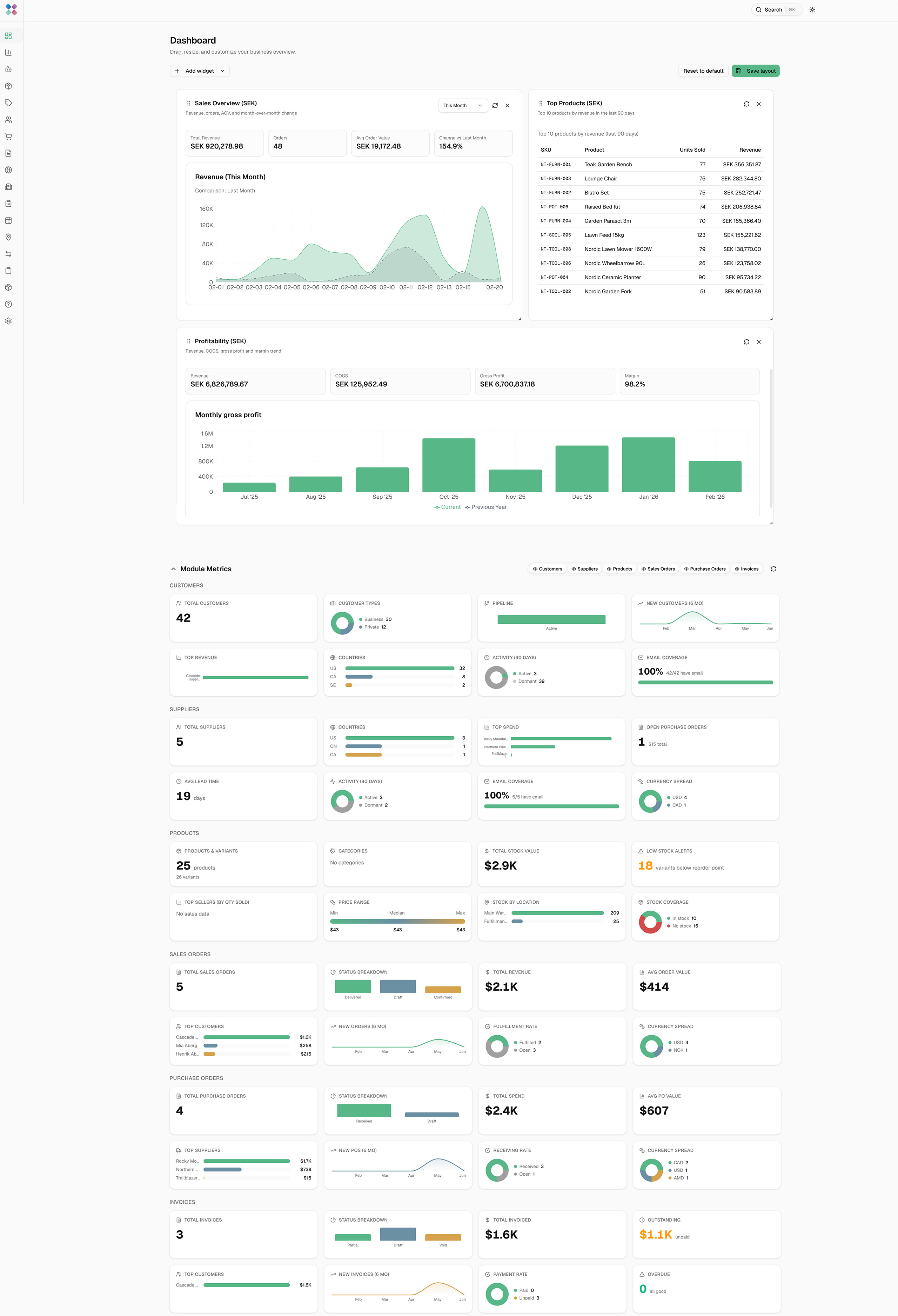
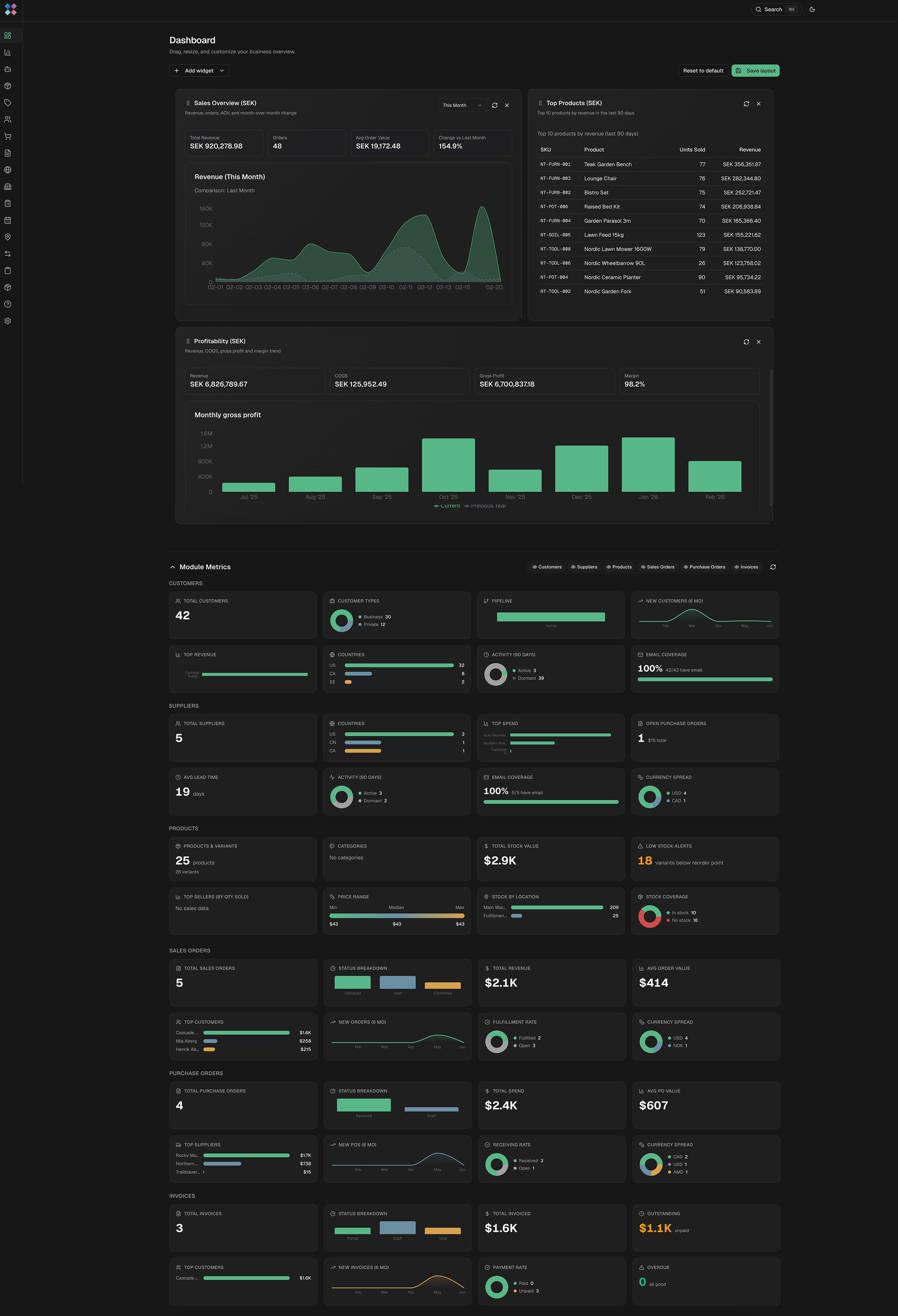
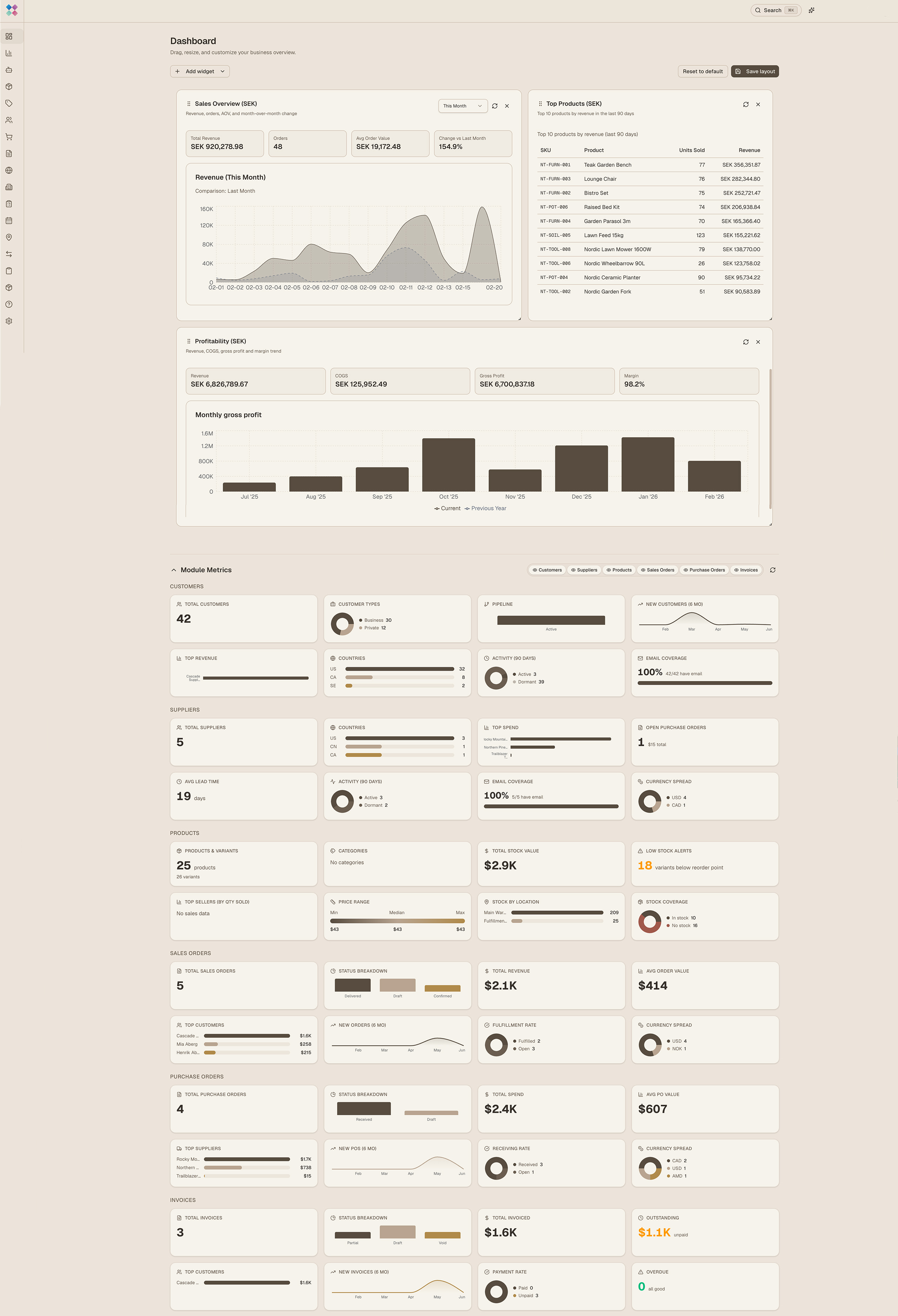
See VNDLY in Action
Watch how VNDLY helps product businesses manage inventory, sales, and forecasting.
Spreadsheets vs VNDLY
Spreadsheets aren't a bad tool. They're genuinely flexible and they scale further than most people expect. But 'further than expected' has a hard ceiling, and most product businesses hit it somewhere between 50 and 200 SKUs, not because they're doing anything wrong, but because spreadsheets require a human to be the database, the logic layer, and the integrity check all at once. Here's an honest look at where that breaks down and what the switch actually looks like.
Why spreadsheets break down as you grow
The core problem isn't the spreadsheet itself, it's that a spreadsheet is a static file pretending to be a live system. Every stock update is a manual entry. Every purchase order lives in a separate tab or a different file that someone else may have open. Every time a sales order ships, someone has to remember to reduce the master count, and if they forget, or if two people edit simultaneously, the numbers are wrong and you won't know until you've already oversold.
Multi-location is where it truly falls apart. A single-warehouse business can manage with a well-maintained sheet, but add a second warehouse or a 3PL and you're reconciling multiple files, hoping column names stayed consistent across versions, and doing mental gymnastics to get a true on-hand count. Spreadsheets have no row-level locking, no audit trail, and no automatic recalculation when a purchase order is only partially received, so drift accumulates, and drift compounds.
Where VNDLY is different
VNDLY holds your stock, orders, and supplier data in a single consistent database. When a purchase order is raised, stock is reserved. When goods arrive, quantities update automatically by location and the landed cost, including freight and duties, is averaged in using AVCO costing, with no formula to maintain. When a sales order ships, on-hand decreases and the fulfillment history is recorded without anyone touching a cell.
The AI layer is BYOK (bring your own OpenAI or Anthropic key) and is built into every plan at no extra charge. Ask plain-English questions against your live data: 'What do I need to reorder in the next 30 days?' or 'Which SKUs are most likely to stock out this quarter?' In a spreadsheet, that requires building and maintaining a forecasting model. In VNDLY it's a native feature that reads your actual purchase history and sales velocity.
What staying on spreadsheets actually costs
There's a fair monetary argument for spreadsheets: they're free (or bundled into Microsoft 365 or Google Workspace you're already paying for). VNDLY starts at $49/month. That's a real number. But the relevant comparison isn't '$0 vs $49', it's the time cost of maintaining the sheet, the error rate, and the revenue risk from overselling, understocking, or shipping against stale data.
Most businesses that contact us after outgrowing their spreadsheet point to a specific, costly event: a customer oversell that needed a refund and an apology, a container received with no one certain which version of the file was current, or a month-end reconciliation that consumed two full days of manual cross-checking. $49/month is typically less than an hour of a founder's time resolving a single data-integrity incident, and those incidents tend to recur.
Who this is (and isn't) for
VNDLY is a good fit if...
- You track inventory across more than one location, warehouse, or 3PL and the multiple-tab approach is causing reconciliation headaches.
- You've had at least one oversell, stockout, or data incident caused by a formula error or a stale version of the file.
- Manually updating stock counts after each shipment is eating meaningful time for someone on your team.
- You sell wholesale and need a buyer-facing B2B portal without building one inside a spreadsheet or a separate tool.
Spreadsheets are still fine if...
- You carry fewer than 30, 50 SKUs, sell through a single channel, and have one person managing stock full time.
- Your order volume is low enough that manual updates take under 15 minutes per day.
- You're pre-revenue or in a very early test phase and cost is the binding constraint.
- You've already automated your Sheets or Excel workflow with app integrations and it's genuinely working without errors.
Signs it's time to switch
5 signs you've outgrown your inventory spreadsheet
These aren't edge cases, they're the most common reasons businesses contact us. If more than one applies, the cost-benefit math has likely already shifted.
- 1
You manually cross-check multiple tabs before shipping an orderOur pick
If confirming available stock requires opening more than one file, you've already built an error into your workflow, and someone will eventually skip that step under time pressure.
Best for: Any team where stock accuracy depends on a person doing it right every single time
- 2
You've oversold a product because two people updated the same sheet at once
Spreadsheets have no row-level locking. Two open tabs, the last save wins, and your stock count is silently wrong until a customer complains.
Best for: Multi-person teams sharing a live inventory file
- 3
Your month-end stock reconciliation takes more than a few hours
Reconciling purchase receipts, shipped orders, and on-hand counts against what the sheet says is a fully manual job, and the longer you wait between checks, the bigger the gap.
Best for: Businesses doing regular physical counts to find where the sheet drifted
- 4
You carry stock across more than one location or warehouse
Multi-location in a spreadsheet means separate files or tabs, each with its own update discipline and version control. Eventually one of them falls behind.
Best for: Any business with more than one physical stock location or 3PL
- 5
You can't answer 'what do I need to reorder this month?' without building a formula first
Demand forecasting in a spreadsheet requires building and maintaining a model. In a purpose-built system, it's a native output that reads your actual purchasing and sales history automatically.
Best for: Businesses with seasonal SKUs, variable lead times, or multiple suppliers per product
Integrations
Connect the commerce stack you already trust.
Plug VNDLY into your store, shipping, and accounting tools in minutes.











Trusted by growing businesses.
See what inventory and sales teams are saying about VNDLY.

“VNDLY's purchase order workflow got me from signup to first PO in under an hour. Inventory tracking across my store and pop-ups is finally in one place instead of scattered spreadsheets.”

“Implementing this system has significantly boosted our productivity and streamlined our warehouse operations.”

“Before VNDLY we had no real system, just spreadsheets and a lot of manual work. Since switching, our order processing is faster, stock accuracy has improved significantly, and invoicing takes a fraction of the time.”
Pricing
Plans that grow with your operation.
Starter
$49/mo
For small businesses and solo entrepreneurs
- Users: 2
- Locations: 2
- E-Commerce Stores: 2
- Orders / month: 500
- Full order-to-ship pipeline
- Mobile App & Barcode Scanning
- Serial Number Tracking
- Lot / Batch Tracking
- VNDLY AI (BYOK)
- Planning & Forecast
- Sales Strategy
- Packing Visualizer
- CRM & Sales Pipeline
- Development Projects
- Marketing & Email Campaigns
- Reports & Analytics
- PDF & CSV Export
- API & Integrations
- B2B Customer Portal
- Sales Agents (Beta)
- Custom Integrations*
- Custom KPIs & Reports*
Professional
Most popular$149/mo
For growing businesses with a team
- Users: 10
- Locations: 5
- E-Commerce Stores: 10
- Orders / month: 5,000
- Full order-to-ship pipeline
- Mobile App & Barcode Scanning
- Serial Number Tracking
- Lot / Batch Tracking
- VNDLY AI (BYOK)
- Planning & Forecast
- Sales Strategy
- Packing Visualizer
- CRM & Sales Pipeline
- Development Projects
- Marketing & Email Campaigns
- Reports & Analytics
- PDF & CSV Export
- API & Integrations
- B2B Customer Portal
- Sales Agents (Beta)
- Custom Integrations*
- Custom KPIs & Reports*
Enterprise
$349/mo
For large organizations with high volume
- Users: Unlimited
- Locations: Unlimited
- E-Commerce Stores: Unlimited
- Orders / month: Unlimited
- Full order-to-ship pipeline
- Mobile App & Barcode Scanning
- Serial Number Tracking
- Lot / Batch Tracking
- VNDLY AI (BYOK)
- Planning & Forecast
- Sales Strategy
- Packing Visualizer
- CRM & Sales Pipeline
- Development Projects
- Marketing & Email Campaigns
- Reports & Analytics
- PDF & CSV Export
- API & Integrations
- B2B Customer Portal
- Sales Agents (Beta)
- Custom Integrations*
- Custom KPIs & Reports*
Moving off spreadsheets to VNDLY
You don't need to rebuild from scratch. If your spreadsheet is reasonably organized, the migration is mostly import and verify, not re-entry.
- 1
Export your current stock data as CSV
Pull your SKU list, descriptions, categories, unit costs, and current on-hand quantities from your spreadsheet. VNDLY's importer maps standard columns automatically, product name, SKU, barcode, unit cost, and on-hand count.
- 2
Import your supplier list
Add your suppliers, name, contact, lead times, either by CSV import or manually. This sets up the purchasing side so every new purchase order ties back to the correct vendor from day one.
- 3
Connect your sales channels
Link Shopify, WooCommerce, BigCommerce, or Squarespace if you sell online. Orders pull in automatically and stock levels sync back to your storefront so overselling is blocked at the channel level.
- 4
Raise your first purchase order in VNDLY
From this point, incoming stock goes through a proper PO. Receive it fully or partially, and landed cost, including freight, is averaged into your unit cost automatically using AVCO.
- 5
Keep the spreadsheet read-only for a week, then archive it
Most teams leave the old sheet visible but stop updating it for a few days while they build confidence in VNDLY's stock numbers. Once the two agree, the spreadsheet gets archived as a historical record.
FAQ
Common questions
It depends on order volume and team size. If you're spending more than a few hours a month reconciling stock counts, fixing formula errors, or manually updating inventory after each shipment, the $49/month starting price is likely covered by time savings alone. If you process fewer than 20 orders a month and one person manages stock without errors, a well-maintained spreadsheet may still be the right tool.
Yes. VNDLY supports CSV import for products (SKU, description, on-hand quantity, unit cost), suppliers, and customers. If your spreadsheet columns follow a standard format the importer maps them directly. You can also import open purchase orders so in-transit stock stays accurate through the switch.
Yes. VNDLY integrates with Shopify, WooCommerce, BigCommerce, and Squarespace. Orders pull in automatically and stock levels sync back to your storefront so overselling is prevented at the channel level.
Yes. Multi-location is a native feature, stock is tracked per location, purchase orders can receive into specific warehouses, and you see a real on-hand count across all locations without maintaining a separate tab for each one.
Your historical data can be imported as opening stock balances. VNDLY's transaction history starts from your go-live date, but your opening quantities and costs reflect your existing records. Most teams archive (not delete) the old spreadsheet as a permanent historical reference.
14 days with full access to all features. No credit card required to start.
Yes. VNDLY supports CSV import for products, customers, and suppliers. You can also sync directly from Shopify, WooCommerce, BigCommerce, Squarespace, and other platforms.
VNDLY integrates with Shopify, WooCommerce, BigCommerce, Squarespace, PrestaShop, Magento, Xero, Visma, EasyPost, Sendcloud, Fraktjakt, and more. New integrations are added regularly.
Absolutely. VNDLY uses row-level security, AES-256 encryption for API keys, and runs on enterprise-grade infrastructure. Your data is isolated per tenant and backed up continuously.
Yes. All plans support multi-location inventory with stock transfers, per-location stock levels, and location-specific reporting.
Bring your own OpenAI or Anthropic API key. The AI queries your real business data to generate reports, detect anomalies, compare periods, and answer questions in natural language.
Yes. Refer customers to VNDLY and earn 20% recurring commission for as long as they stay, tracked through Rewardful with a 60-day cookie window. Payouts via PayPal once you hit $50. Apply at vndly.io/partners.
Yes. No contracts, no cancellation fees. You can downgrade or cancel from the billing page at any time. Your data stays accessible until the end of your billing period.
Yes, save approximately 17% with annual billing compared to monthly. You can switch between monthly and annual at any time.

Earn with VNDLY.
Refer inventory and sales teams to VNDLY and earn 20% recurring commission for every customer you bring in, for as long as they stay.
Ready to run inventory without guesswork?
14-day free trial, no credit card required. Set up your first products and start selling today.