
Order Management Systems: What They Do & How to Pick
What is an order management system, how does it work, and which one fits your business in 2026? Plain-English SMB guide to features, pricing, and top picks.
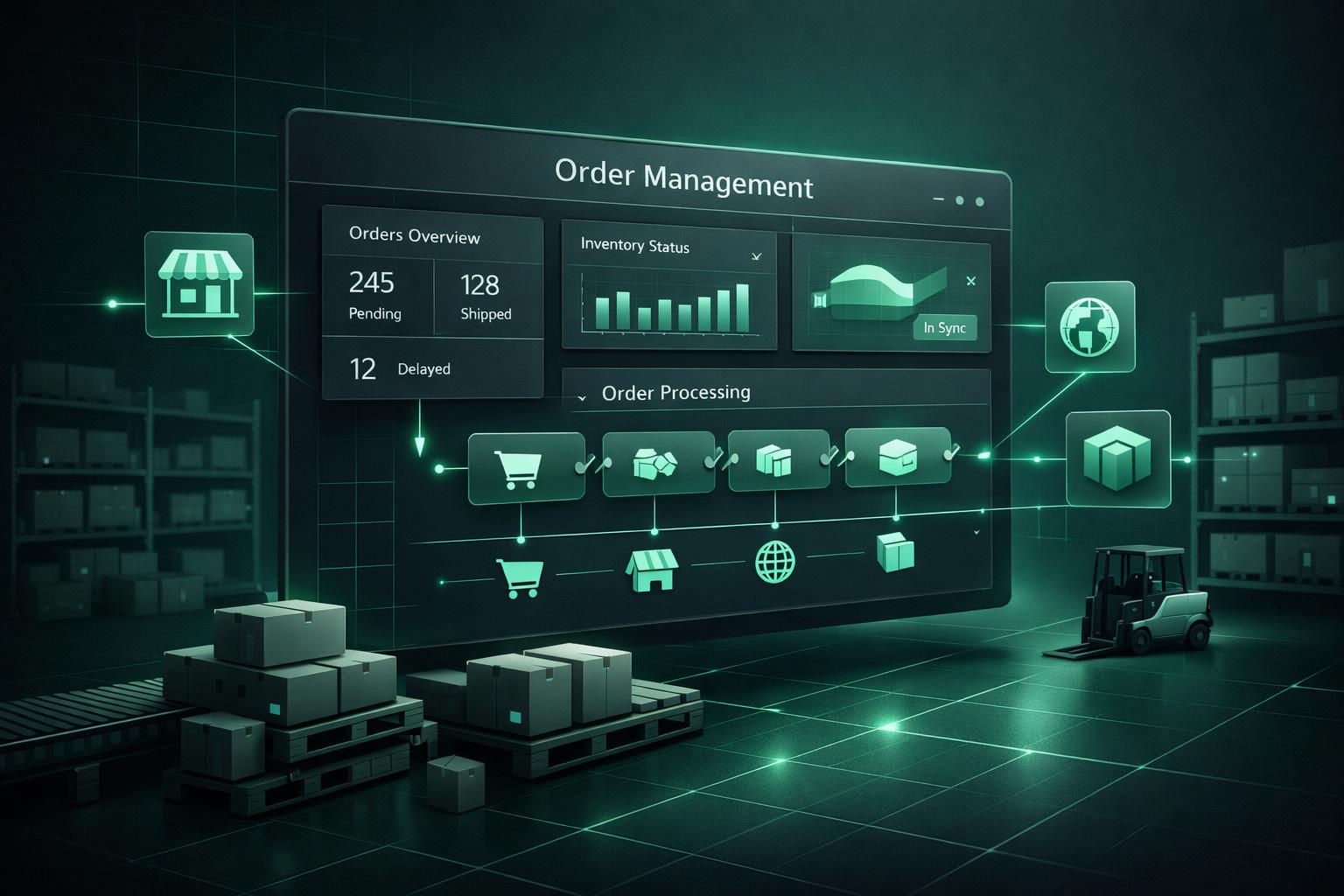
Order Management Systems: What They Do and How to Pick One in 2026
If you're managing orders across more than one channel, Shopify, wholesale buyers, Amazon, your own sales reps, you've probably hit the wall where spreadsheets or your ecommerce platform's native tools stop working. That's where an order management system (OMS) comes in.
This guide explains what an OMS does, how it differs from inventory software and ERP, which features matter, and which platforms make sense for SMBs in 2026.
What Is an Order Management System?
An order management system (OMS) is software that manages the full lifecycle of a customer order, from the moment it's placed, through picking, packing, shipping, and fulfilment, to returns and post-sale support.
The core job is to make sure every order gets fulfilled accurately, on time, with full visibility across your team.
For a small brand selling through one Shopify store, your ecommerce platform does the basics. But the moment you add a second sales channel, a wholesale account, an Amazon listing, a B2B portal, phone orders, you need something that consolidates orders, tracks inventory across all channels, and routes each order to the right fulfilment path. That's what an OMS does.
The Order Lifecycle: What an OMS Manages
A good OMS touches every step of the order process:
- Order capture, pulls in orders from all channels (ecommerce, EDI, B2B portals, phone/manual entry)
- Inventory check and allocation, reserves stock against the order so it can't be double-sold
- Fulfilment routing, decides which warehouse, 3PL, or drop-shipper handles the order
- Pick, pack, ship, generates pick lists, packing slips, and shipping labels
- Tracking and notifications, sends tracking info to the buyer; updates order status in real time
- Returns and RMAs, handles the reverse flow: return authorisations, restocking, credit notes
Without an OMS, each of these steps happens in a different tool, or worse, manually in a spreadsheet. The result is fulfilment delays, oversells, mis-ships, and an ops team constantly firefighting.
OMS vs Inventory Software vs ERP
The lines between these blur, especially at the SMB level. Here's a clear breakdown:
| | OMS | Inventory Software | ERP | |---|---|---|---| | Primary focus | Order lifecycle management | Stock levels and purchasing | Full business operations | | Who needs it | Multi-channel sellers, B2B brands | Product brands, distributors | Mid-market and enterprise | | Key strength | Order routing, fulfilment, returns | Stock tracking, PO management, cost | Finance, HR, production, supply chain | | Typical cost | $200, $2,000/mo | $50, $500/mo | $10,000+/yr | | Standalone? | Often overlaps with inventory | Often overlaps with OMS | Replaces everything |
In practice, the best platforms for SMBs blur the OMS/inventory line. You get order management and inventory management in one system, without the complexity of ERP. That's the sweet spot for most product brands doing $500K, $10M in revenue.
Key Features to Look For in an OMS
Not all platforms are built the same. For SMBs, prioritise:
Multi-Channel Order Consolidation
All your orders, Shopify, Amazon, wholesale, B2B portal, should flow into one queue. No logging into four dashboards to see what needs to ship today.
Real-Time Inventory Sync
When an order comes in from any channel, stock should update immediately across all other channels. Overselling from inventory lag is one of the most common and avoidable SMB ops problems.
Purchase Order and Supplier Management
An OMS needs to connect inbound (supplier POs) with outbound (customer orders). If you can't see your open POs alongside current stock levels and pending orders, you're flying blind on reordering.
Fulfilment Flexibility
Can the system route orders to different warehouses, 3PLs, or drop-shippers? Can it handle partial shipments if you're out of one line item? These edge cases come up constantly in practice.
B2B / Wholesale Order Support
If any of your revenue comes from wholesale accounts, you need PO-based ordering, custom price lists per customer, and bulk order entry. Consumer-focused OMS tools often treat B2B as an afterthought, check before you commit.
Reporting and Visibility
What's your fulfilment rate? Average days to ship? Top-selling SKUs this month? Backorder rate by supplier? These numbers should be easy to pull without exporting to Excel.
Top Order Management Systems for SMBs in 2026
Here's an honest comparison of the platforms most relevant to product brands and SMBs:
| Platform | Best For | Pricing (approx.) | Strengths | Weaknesses | |---|---|---|---|---| | VNDLY | SMB product brands, wholesale + DTC | From $49/mo | Inventory + OMS in one, strong PO management, B2B wholesale tools | Newer platform, growing integration library | | Linnworks | High-volume multi-channel ecommerce | From $449/mo | Excellent channel integrations, warehouse management | Expensive for smaller operations | | Brightpearl | Growing retail/wholesale brands | From ~$375/mo | Strong automation, Shopify/Magento native | Onboarding cost can be high | | Cin7 Core | SMBs needing inventory + OMS | From $349/mo | Deep inventory features, manufacturing support | UI complexity; support can be slow | | Shopify + apps | Pure DTC, Shopify-only | Varies by app | Native checkout integration | Breaks down for multi-channel; no real B2B |
VNDLY is built for the SMB product brand that sells through both wholesale and DTC. It combines inventory management and order management in a single tool, no stitching together three apps. At $49/month to start, it's accessible for early-stage brands that have outgrown Shopify's native tools but don't want to pay enterprise prices yet.
Linnworks and Brightpearl work well for brands at scale, if you're doing significant volume across many channels and need deep warehouse logic, they're worth the price. But for a brand under $5M revenue, the cost and onboarding complexity is often hard to justify.
Cin7 Core is a solid mid-market choice with strong inventory depth, but the UI has a learning curve and their support has attracted criticism in recent years.
How to Choose the Right OMS
Walk through these questions before committing:
1. How many channels are you selling through? One channel (Shopify only)? Your ecommerce platform probably handles it. Two or more? You need a proper OMS.
2. Do you sell wholesale or B2B? If yes, make sure the platform actually supports B2B workflows: PO intake, custom pricing, bulk order management. Many consumer-focused OMS tools don't, ask specifically before buying.
3. What does your fulfilment look like? Ship from your own warehouse? Use a 3PL? Drop-ship from suppliers? Your OMS needs to support your actual setup, not force you to adapt to its assumptions.
4. How important is inventory management vs order management? If stock accuracy and purchasing are your biggest pain points, a platform that blends both will serve you better than a pure OMS that treats inventory as secondary.
5. What's your actual budget? Be honest. A $450/month Linnworks subscription is real money for a brand doing $800K/year. Start with what fits your stage, and migrate when you've genuinely outgrown it.
The Bottom Line
An order management system isn't optional once you're selling across more than one channel. Which one fits depends on your stage, your model, and your budget.
For SMB product brands, especially those with a mix of wholesale and direct sales, the right move is usually a platform that handles both inventory and order management together. Less integration overhead, lower cost, and one place to see the full picture.
VNDLY combines inventory management and order management in a single SMB-focused platform. Start a free 14-day trial at vndly.io, no credit card required.
If you're ready to move beyond a guide and into a working tool, VNDLY's order management system is built for small and mid-sized product businesses.
Related articles
- GuidesWhen Manufacturers Need MRP Software [2026 Guide]
- GuidesSerial Number: Meaning, Examples + Tracking Guide [2026]
- GuidesBonded Warehouses Explained: What Importers Need to Know
- comparisonTradeGecko Discontinued: What Replaced It, What It Cost, and the Best Alternatives in 2026
- Industry InsightsCross-Border Ecommerce Statistics 2026: Top Global Trends
- StrategyVNDLY vs inFlow Inventory: Which Is Right for Your Business?