
Supply Chain Disruption Costs for SMBs: 2026 Data
New data: 96% of SMBs were hit by supply chain disruptions in 2026. See the real costs, what resilient companies do differently, and how to protect margins.
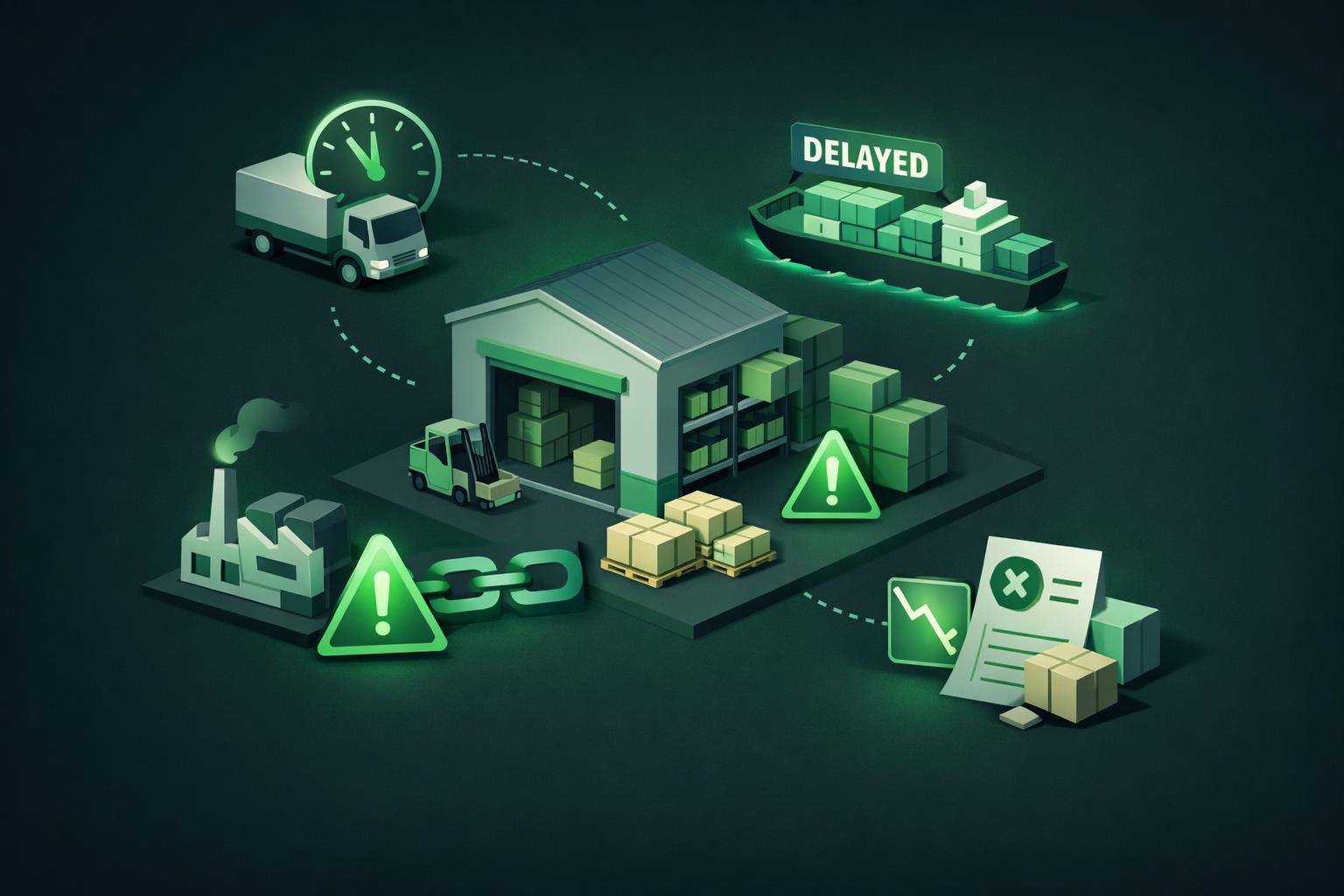
Supply Chain Disruption Costs for SMBs in 2026
Supply chain disruption is no longer a once-a-year headache for small and mid-sized businesses. It is the new normal. In 2026, 96% of U.S. SMBs reported that tariffs, shipping delays, or supplier failures directly hurt their operations within the past 12 months (Ship4wd, April 2026). For businesses already running on thin margins, these shocks do not just dent revenue. They erode customer trust, inflate operating costs, and force reactive decisions that compound over time.
This post breaks down the numbers behind 2026's disruption landscape, what the data says about who is vulnerable, and what resilient SMBs are doing differently to stay ahead.
The 2026 Disruption Landscape by the Numbers
Global supply chains are under sustained pressure. According to Kearney's Supply Chain Navigator 2026 H1 Briefing, supply chain costs are rising 2.3% to 4.0% above baseline inflation because of geopolitical fragmentation, regulatory complexity, and labor market tightness. Even as container shipping rates dropped 47% year-over-year due to excess capacity, a "rising structural cost floor" is becoming a permanent part of operations.
The financial impact is staggering. Marsh and Swiss Re estimate the annual global cost of supply chain disruptions at $184 billion. For individual companies, a single major disruption can wipe out up to 42% of annual EBITDA (McKinsey). And these are not rare black-swan events. Resilinc's EventWatchAI recorded a 38% year-over-year increase in disruption alerts during 2024, 2025.
⚡ The Preparedness Gap
78% of supply chain leaders expect disruptions to intensify, yet only 25% feel prepared to handle them. For SMBs with fewer resources and no dedicated risk teams, this gap is even wider.
Disruption Categories on the Rise
Everstream Analytics and Resilinc tracked dramatic year-over-year increases across nearly every risk category:
| Risk Category | YoY Increase | |---------------|-------------| | Flood-related alerts | +214% | | Human health disruptions | +143% | | Regulatory changes | +92% | | Cyber events | +64% | | Geopolitical instability | +54% | | Climate / extreme weather | +33% |
Geopolitical instability now carries a 97% threat level. That is higher than climate risk at 93%. For SMBs sourcing internationally, that means lead time variability, sudden tariff changes, and supplier shutdowns are no longer edge cases. They are baseline planning assumptions.
How SMBs Are Getting Hit, The Ship4wd Data
A survey of 500 U.S. SMBs conducted in April 2026 by Ship4wd shows the ground-level reality:
- 73.4% said tariffs were the top factor impacting their supply chain
- 71% cited rising shipping costs
- 53.6% reported delayed deliveries
- 44.6% experienced supplier disruptions
The consequences go beyond higher invoices. 61.6% of SMBs missed out on sales due to disruptions. 56.2% suffered inventory shortages or stockouts. And 50.8% saw customer dissatisfaction or churn as a direct result. 13% lost repeat customers permanently because of shipping and delivery problems.
The Visibility Problem
72% of SMB respondents said they lack full real-time visibility into their shipping and sourcing operations. Without knowing where inventory is across suppliers, in transit, and in warehouses, businesses cannot make proactive decisions. They are forced to react after the damage is done.
This visibility gap is especially costly because of what the data calls "synthetic stockouts": channel-specific out-of-stock events where physical inventory exists but is misallocated. A seller with 240 units in a warehouse might show out-of-stock on one channel while another channel has 48 unsold units sitting idle. A single day of this misallocation can cost over $2,000 in lost orders, ranking penalties, and wasted ad spend.
What Resilient SMBs Are Doing Differently
Despite the headlines, the data also points to clear strategies that work. SMBs taking a proactive, technology-driven approach are outperforming those stuck in reactive mode.
1. Building Strategic Inventory Buffers
59% of SMBs are stockpiling inventory as their primary coping strategy, and 58.8% report increasing inventory levels overall. The just-in-case model is replacing pure just-in-time for businesses that cannot afford a stockout. The key is doing this intelligently, with demand forecasting and SKU-level analysis, rather than blanket overordering that creates dead stock.
2. Investing in Technology and AI
91% of surveyed SMBs are already using AI in some form within logistics operations. 51% have adopted technology for real-time tracking and AI forecasting. Companies with AI-driven forecasting tools reduce forecast errors by 30, 40% (ZipDo, 2026). That translates directly to fewer stockouts, less excess inventory, and better cash flow.
The inventory management software market is projected to reach $5.8 billion by 2026 (CAGR 10.2%), reflecting broad recognition that spreadsheets and gut feel are no longer sufficient.
3. Diversifying Suppliers and Routes
42% of SMBs expanded shipping routes or entered new markets in the past year. Supplier diversification can reduce supply chain risk by up to 40%. For SMBs, this might mean adding a secondary supplier in a different region, or splitting orders across two freight forwarders instead of one.
See how VNDLY handles multi-supplier visibility. Real-time stock tracking, AI-powered demand forecasts, and automated reorder alerts, all in one place. Free 14-day trial, no credit card.
Try VNDLY free →The Hidden Costs Nobody Talks About
Direct stockout losses are easy to measure. The hidden costs are what kill margins over time.
Inventory carrying costs, storage, insurance, financing, obsolescence, and shrinkage, typically run 20, 30% of average inventory value annually. For a business holding $200,000 in stock, that is $40,000, $60,000 per year in carrying cost. The global average was 20.8% in 2022 (ZipDo), and with rising interest rates and warehouse rents, that figure has likely increased.
Meanwhile, 20.3% of firms reported inventory inaccuracies in 2023 (WifiTalents), and firms with inaccurate records experience 2.1x more stockouts. Poor item-level accuracy forces 55% of warehouse operators to spend extra labor on rework and reconciliation.
And then there is the spreadsheet problem. 44% of inventory planning teams still use spreadsheets as their primary tool. Spreadsheets do not update in real time. They do not flag when a supplier is late. They do not warn you that a SKU is about to stock out next week. They are static snapshots of a moving system.
From the Founder
I have lived through every version of this nightmare. When I ran my product company, we went from ordering one container every six months to over 75 per year. Each growth phase meant a new warehouse, new staff, and new systems, and every time, the gap between what we thought we had in stock and what was actually on the shelf got wider.The worst pain was not the big disruptions. It was the death by a thousand cuts: a priority customer calling mid-week demanding rush delivery, overtime to repack and re-ship, freight costs spiking because we had to air-freight instead of sea-freight. We tried TradeGecko, we tried spreadsheets, we tried everything. Nothing gave us the full picture. That is why I built VNDLY. Not because inventory software is a fun category, it is not. But because the difference between a business that survives disruption and one that drowns in it often comes down to one thing: knowing what you have, where it is, and what you will need before you need it.
What the Data Says About 2027 and Beyond
Looking ahead, three structural shifts will define the next phase of supply chain management for SMBs:
1. The tariff absorption wall is approaching. 73% of supply chain leaders expect to hit the point where tariff costs can no longer be absorbed internally and must be passed to consumers (Tradeverifyd, 2026). For SMBs, this means pricing pressure and margin compression are not temporary. They are the new baseline.
2. AI is moving from nice-to-have to mandatory. 72% of supply chain executives now believe automated mitigation capabilities are mandatory for navigating modern disruptions. SMBs that delay adoption will face a widening capability gap against competitors who can forecast, plan, and respond faster.
3. Real-time visibility is the new minimum. 83% of organizations absorb at least a portion of tariff costs to maintain price stability, but only 56% can trace material origins to Tier-3 or Tier-4 suppliers. For SMBs, the first step is simpler: know what is in your own warehouses and what is in transit. You cannot manage what you cannot see.
Key Takeaways
- 96% of SMBs were directly impacted by supply chain disruptions in 2026, this is not a niche problem
- The average disruption costs $1.5 million per day for large enterprises; for SMBs, the proportional impact is often worse
- 72% lack real-time visibility, which creates synthetic stockouts and reactive decision-making
- AI-driven forecasting reduces errors by 30, 40% and is becoming a baseline requirement
- Strategic inventory buffers, supplier diversification, and technology investment are the three pillars of resilience, a modern purchase order automation workflow covers all three on the supply side
Start a 14-day free trial of VNDLY, no credit card required. Get real-time stock visibility, AI-powered demand forecasts, and automated reorder alerts.
Sources: Ship4wd SMB Supply Chain Survey (April 2026); Kearney Supply Chain Navigator 2026 H1; Marsh / Swiss Re Global Supply Chain Risk Report; Resilinc EventWatchAI; McKinsey & Company; Tradeverifyd Supply Chain Executive Survey 2026; ZipDo Inventory Statistics 2026; WifiTalents Inventory Statistics 2026; Everstream Analytics; Federal Reserve Bank of New York GSCPI.
Related articles
- Industry Data20% Inventory Carrying Costs: 2026 Data & Ways to Cut Them
- Industry Data$30 Per Picking Error: The Real Cost [2026 Data]
- Industry DataIs Warehouse Automation Worth It? 18-Month Payback Data
- Industry DataSupplier Lead Times Average 10 Days: The Real Cost
- Industry Data38% of SMB Inventory Is Excess Stock [2026 Overstock Data]
- Industry Data63% Inventory Accuracy: What Bad Stock Data Costs (2026)